
Plant nutrition and nutrients
The interaction between the physical, chemical and biological components of soil determines nutrient availability to plants. Understanding these processes and the influence of environmental conditions allows us to improve nutrient availability and plant productivity.
The quantity of nutrients a plant needs for healthy growth and development depends on:
• Plant species and variety; • Yield potential; • Soil properties; • The environment; • Management practices.
These factors also strongly influence the quantity of nutrients that must be supplied. When the soil cannot provide enough nutrients, its reserves need to be replenished with mineral or organic fertilisers. To determine the exact amounts to apply, we must assess both the crop’s nutritional requirements and the quantities of plant-available nutrients already in the soil.
Plant nutrients — macronutrients and micronutrients
Nitrogen accounts for 1-6% of plant mass and is absorbed as NO3- and NH4+. It is one of the key elements involved in building proteins and nucleic acids. Nitrogen is also an integral part of chlorophyll, which converts the light required for photosynthesis into chemical energy.
An adequate nitrogen supply is associated with high photosynthetic activity, vigorous vegetative growth, a dark green colour and protein content in the plant’s fruit.
Excess nitrogen, particularly when associated with deficiencies of P, K and S, can delay fruit ripening. In many plants growing under fertile conditions, excessive nitrogen causes uncontrolled vegetative growth and increases the incidence of foliar diseases. In semi-arid and arid climates, vigorous early-season growth can deplete soil moisture before the reproductive stage, when the plant is especially sensitive to water stress.
Nitrogen supply affects carbohydrate use. When N is adequate and environmental conditions favour growth, the carbohydrates produced help form proteins. Under low N conditions, carbohydrates are incorporated into vegetative cells, causing them to thicken and produce more protoplasm, described as a water-filled structure. Excess water content weakens cotton fibres and may cause lodging in cereals, especially when K supplies are low. Excessive moisture often increases the risk of disease and insect damage.
Phosphorus content in plants ranges from 0.1-0.5%, considerably lower than N and K concentrations. Plants absorb both H2PO4- and HPO4-, as well as soluble, low-molecular-weight organic phosphorus compounds such as nucleic acids and chitin.
The main function of phosphorus is to store and transfer energy for growth and reproduction. Adequate phosphorus is associated with faster root growth. Applying sufficient soluble phosphorus as H2PO4- near the roots encourages them to spread through the treated soil. Similar effects occur when the root zone is treated with solutions containing NO3- and NH4+. Root growth expands the area from which the plant can obtain water and nutrients: the larger the soil volume explored by roots, the greater the uptake of minerals and moisture. Phosphorus is also a key element in fruit and seed development and reduces the time needed for ripening.
Potassium is absorbed by plant roots as K+ and accounts for 1-5% of plant dry matter.
Potassium is essential for high crop quality. It participates in the synthesis and transport of photosynthetic products to reproductive and storage organs, including grain, fruit and bulbs, and in their subsequent conversion into carbohydrates, proteins, fats and other products. In fruit and vegetables, adequate potassium increases fruit size, improves colour and flavour, and thickens the skin, all of which are important for a high-quality harvest and storage with minimal losses.
Sulphur is absorbed by roots as sulphate, SO4-2. Its concentration in plants generally ranges from 0.2-0.5%. Sulphur is required for the synthesis of S-containing amino acids — cystine, cysteine and methionine — which are essential components of plant proteins. Cysteine and methionine levels increase as leaf sulphur content rises. S deficiency slows growth; plants stop growing, become smaller and develop chlorosis.
Calcium (Ca+) concentration in plants ranges from 0.2-1.0%. Plants absorb it from the soil solution. Calcium regulates the movement of carbohydrates and proteins. When calcium is deficient, excessive carbohydrates accumulate in leaves and their levels decline in stems and roots, impairing normal root function. Water and nutrient uptake also decline because the plant no longer has sufficient energy reserves for these processes. Ultimately, Ca+ stress causes defects and poor development in the storage organs of many fruits and vegetables, including fruit and bulbs.
Plants contain 0.1-0.4% Mg+2. As a key component of chlorophyll, Mg+2 is essential for photosynthesis. Chlorophyll contains 15-20% of the plant’s total magnesium. Magnesium is also a structural component of ribosomes. When Mg+2 is deficient, protein nitrogen increases and non-protein N decreases. In many plants, magnesium deficiency causes interveinal chlorosis, with only the leaf veins remaining green. Prolonged Mg+2 deficiency causes leaf tissues to progress from chlorosis to necrosis. In some species, lower leaves turn reddish-pink, gradually become brown and eventually develop necrosis.
Micronutrients
Micronutrients are just as important as macronutrients. They are called “micro” because they occur in smaller quantities in plants and soil. Micronutrient deficiencies cause stress and yield reductions similar to those caused by macronutrient deficiencies. When soil supplies are inadequate, they must therefore be replenished with mineral or organic fertilisers. The listed plant micronutrients include iron, zinc, copper, manganese, boron and molybdenum, along with additional elements such as cobalt, sodium, silicon, selenium and chlorine.
How do nutrients enter plants?
Only in legumes is atmospheric nitrogen converted into nitrate by bacteria in root nodules. In other cases, nutrients must be supplied through the roots, with foliar application providing supplementary nutrition.
Roots absorb nutrients as cations and anions from the soil solution and release small quantities of ions — H+, OH- and HCO3- — back into the soil to maintain electrical neutrality. As roots take up ions, nutrient concentrations in the soil solution decrease, activating biological and chemical processes that replenish the depleted ions.
Nutrient movement towards roots:
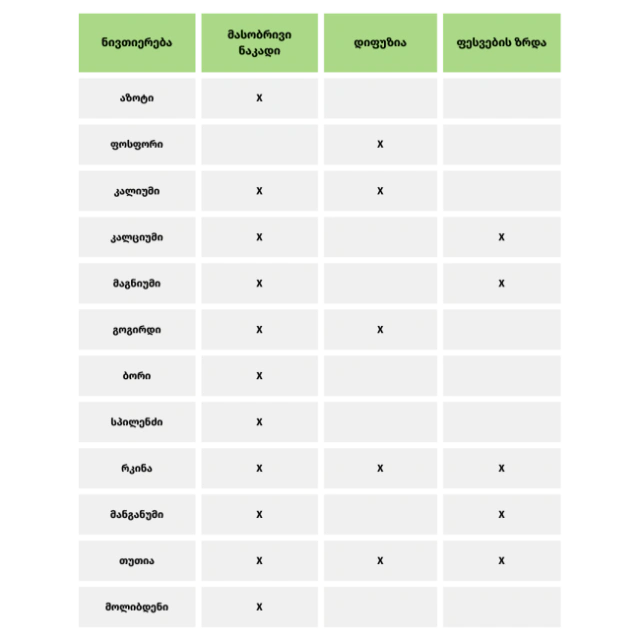
Macronutrients and micronutrients reach the root system through several mechanisms: mass flow, diffusion, continuous root-hair formation and root growth, and selective uptake.
Mass flow
Mass flow of nutrients towards roots is driven by transpiration. Roots take up water and its dissolved nutrients as they replace water lost through transpiration.
In fertile soils, mass flow generally delivers 7-10 times more calcium and sodium than required. Magnesium is usually supplied in adequate amounts, whereas phosphorus is supplied below requirements. Potassium may also be delivered, but sometimes only at 1/10 of the plant’s needs.
Diffusion
Nutrient diffusion occurs when ions move towards roots faster than they would through mass flow driven by transpiration. This movement results from an increased concentration gradient.
Definition: A concentration gradient is the difference in a substance’s concentration between different locations. Substances diffuse down their gradients, from higher to lower concentrations.
Root growth and root hairs
Root growth and the exploration of a larger soil volume are particularly important for slowly diffusing nutrients such as phosphorus. The formation of new primary roots and additional root hairs is therefore a prerequisite for phosphorus and other nutrient uptake.
Selective uptake
The absorption of nutrients from the soil solution may be restricted, particularly when an element is present in excess, because:
- Roots can select, to some extent, which nutrients they absorb.
- The concentration of ions of the same element differs between plant roots and the soil solution.
Two mechanisms of selective uptake are recognised:
- Selection of nutrients for uptake: Substances absorbed through the roots by ion exchange are used, stored and subsequently released by the plant. Ion exchange across root membranes can occur through cation exchange, diffusion or specific ion carriers.
- Only a portion of the nutrients absorbed by the roots is transported upwards to other parts of the plant.
Inorganic and organic fertilisers
Nutrients in solid organic fertilisers and soil organic matter are generally not immediately available for root uptake.
Their availability depends on the rate at which soil microorganisms break down organic matter. When conditions are unsuitable for microbial activity, such as low pH, very dry soil or excessive moisture, only small quantities of nutrients become available to the plant.
Although solid organic fertilisers release nutrients slowly, they remain an excellent long-term source of macronutrients and micronutrients. Organic matter plays a major role in maintaining good soil structure and is important for retaining both nutrients and moisture.
Orchard soil management must include the addition of organic matter both before and after planting.
For example, relying exclusively on herbicides for weed control and mineral fertilisers for nutrition depletes soil organic matter, degrades soil structure and increases the risk of erosion.
Recommended soil-management practices include:
- Mulching planting rows with organic materials.
- Establishing a green cover in the rows during winter, then managing it in spring with suitable tilling or mulching equipment, or a herbicide, to prevent competition with the crop.
When should fertilisers be applied?
Traditionally, NPK fertilisers were applied to orchards from late winter to early spring. A single annual application was inexpensive, and movement from the soil surface to the roots depended on rainfall during that period.
This approach has several disadvantages:
(a) Some nutrients, especially nitrogen, leach into deeper soil layers and become unavailable to roots when new shoots begin to grow. The plant normally starts taking up nutrients from the soil around the development of new green growth, before new shoot growth begins.
(b) A large one-off fertiliser application can create a mineral imbalance in the soil.
(c) Nutrients that are not readily retained by the soil’s exchange complex can leach out, creating shortages in summer while the plant still needs them.
Studies on sweet cherries in the United States have shown the importance of nitrogen application from harvest through late summer for developing strong flower buds and initiating new shoot growth the following spring.
Flowering in the following year, as well as the early stages of shoot growth and fruit development, depends on the nitrogen reserves accumulated after harvest.
The plant’s nutrient requirements vary throughout the season.
Fertiliser application timing and rates can be determined according to the plant’s developmental stages.
Stage 1: Flowering and fruit set
After winter dormancy, the plant resumes growth in spring. Flowering and early fruit and shoot development rely largely on nutrient reserves from the previous year. New nutrient uptake from the soil becomes fully active around the time leaves reach their full size and shoot growth accelerates.
Stage 2: Shoot growth
During rapid shoot growth, fruit growth slows but does not stop. Nutrients absorbed from the soil during this period are used mainly for shoot development.
Stage 3: Rapid fruit growth
This stage occurs 3-4 weeks before harvest, when fruit increases rapidly in size. The main priority is to prevent water stress. Fertilisers, particularly nitrogen, should not be applied during this period.
Stage 4: After harvest
During this period, the plant builds nutrient reserves for the following spring. Once summer tree growth has stopped, approximately 50% of the total fertiliser amount can be applied. These nutrients move into the leaves, buds and shoots and are stored in the tree’s woody tissues and roots before leaf fall.