
Managing plant growth and stress with phytohormones
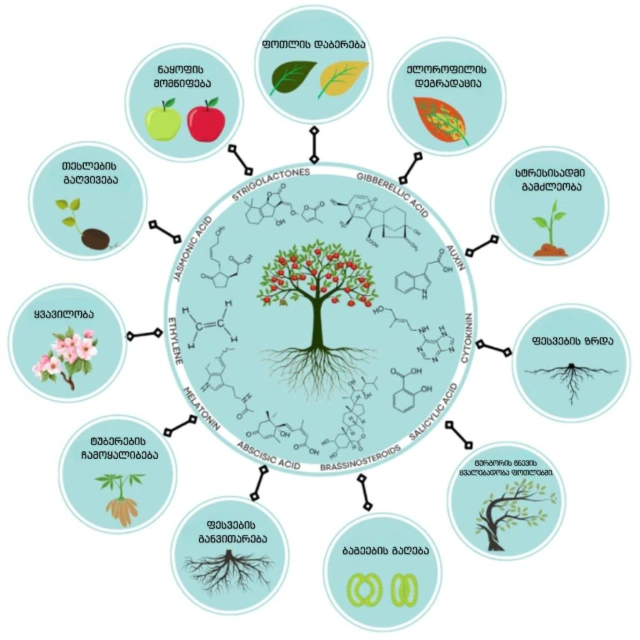
Phytohormones play a crucial role in regulating plant growth and responses to abiotic stress by synchronously activating the necessary signal-transduction pathways. Transduction is described here as the mechanism by which genetic information is transferred from one cell to another.
They regulate every stage of plant growth and development, including embryogenesis, organ size, defence against pathogens, stress tolerance and reproductive development.
These hormones differ in their chemical structures and functions.
➡️ Auxins – Affect cell elongation, root-system growth and apical dominance. – Determine growth responses to changes in environmental conditions. – Suppress branching and the development of lateral shoots.
➡️ Cytokinins – Stimulate cell division and lateral shoot development. – Delay leaf ageing during the growing season. – Increase transpiration capacity and antioxidant potential.
➡️ Gibberellins – Affect cell elongation, subsequent growth and flowering. – Regulate nitrogen assimilation and the duration of dormancy. – Inhibit chlorophyll degradation and heavy-metal uptake.
➡️ Brassinosteroids – Stimulate indole-3-acetic acid synthesis, cell elongation, division and growth. – Participate in seed germination, reproductive development and the establishment of plant immunity.
➡️ Strigolactones – Participate in seed germination and the development of rhizosphere structure and root architecture. – Play an active role in fruit formation and ripening. – Help symbiotic fungi associate with plant roots. – Inhibit branching.
➡️ Ethylene – Is responsible for young-leaf growth. – Participates in the ageing of green plant parts and in fruit ripening. – Helps the plant cope with stressful conditions, including heat and cold.
➡️ Salicylic acid – Participates in photosynthesis, transpiration, and ion uptake and transport. – Improves photosynthetic performance and mineral nutrition. – Has antioxidant properties.
➡️ Jasmonic acid – Participates in flower formation and leaf ageing. – Regulates responses to biotic stress, such as pathogens and insect pests.
➡️ Abscisic acid – Regulates seed and bud dormancy. – Participates in stomatal opening and closing. – Regulates plant adaptation to abiotic stress. – Is responsible for maximum cortical-cell expansion in root meristems. The cortex is the peripheral tissue of the plant’s axial organs between the endodermis and epidermis.
Many products containing these phytohormones are available on the market. When choosing them, it is important to consider their composition, properties and origin.
The South African company Afrikelp offers Afrikelp DS, an Ecklonia maxima-based biostimulant containing auxin (22 ppm) and cytokinin (0.06 ppm), as well as nitrogen (N) at 0.46% and phosphorus (P2O5) at 1.4%.
Cytoplant, a product from the leading Spanish company Daymsa, stands out for its high cytokinin content of 400 ppm. It also contains water-soluble phosphorus (P2O5 – 3%) and water-soluble potassium (K2O – 3%).
Two other notable Daymsa products, Nuptak and Soillum, do not contain auxin directly but contribute to its production and synthesis. Nuptak’s primary function is nitrogen fixation, although it also has a biostimulant effect. Its bacterial strain, Priestia megaterium CB2001 Min 107 CFU/g, participates in auxin synthesis and improves the plant’s resilience to various stress factors. The bacterial strain in Soillum, Pseudomonas fluorescens strain GR-322, contributes to auxin production by synthesising indole-3-acetic acid. It also effectively protects the root system against various diseases.
The functions of hormones involved in plant growth, development and productivity.